
Akala mo ba, mas mataas ang AAC class, mas wise ang order? Not always.
It’s easy to think the highest class, the heaviest block or the priciest option is the safest choice. But a stronger block is not automatically a better wall. A higher grade usually means more density. That means more weight on your slabs and frames, a bigger bill and, often, less insulation. If your wall only needs to divide a room, you could be paying for strength it will never use.
Smart builders match the AAC class to the job. A hotel partition, a school corridor and a warehouse wall each ask different things of a block. Your engineer weighs the loads, impact, anchors, fire rating and wall restraint, and picks the grade that fits. No overbuilding and no underbuilding.
In this guide, we’ll show you how AAC-2 to AAC-6 differ, why strength and density are two separate choices, and how to match each grade to the right wall. Mas matipid, mas mabilis, at tama ang engineering.
Specifying AAC on your structural drawings isn't a simple blanket purchase order. You cannot just issue a PO for generic "AAC blocks" and expect uniform site performance across all wall types. Material specification requires matching exact floor requirements—such as wall heights, wind load exposures, and fixing loads—to standard compressive strength classes ranging from AAC-2 to AAC-6 as governed by ASTM C1693 and PNS ASTM C1691.
Background
AAC was invented in the mid-1920s and perfected in Sweden by architect and inventor Dr. Johan Axel Eriksson. Commercial production began in Sweden in 1929, establishing AAC as a premier global wall system standard. Blocktec pioneered bringing modern AAC technology into the Philippines back in 2019.
Deep Dive: AAC Strength Grades (AAC-2 to AAC-6) & Density Breakdown
Under ASTM C1693 / PNS ASTM C1691, unreinforced AAC masonry units are strictly classified by their compressive strength class and nominal dry bulk density. Specifying the correct grade ensures your walls meet structural shear and compressive demands without adding unnecessary structural mass or overspending on material supply.
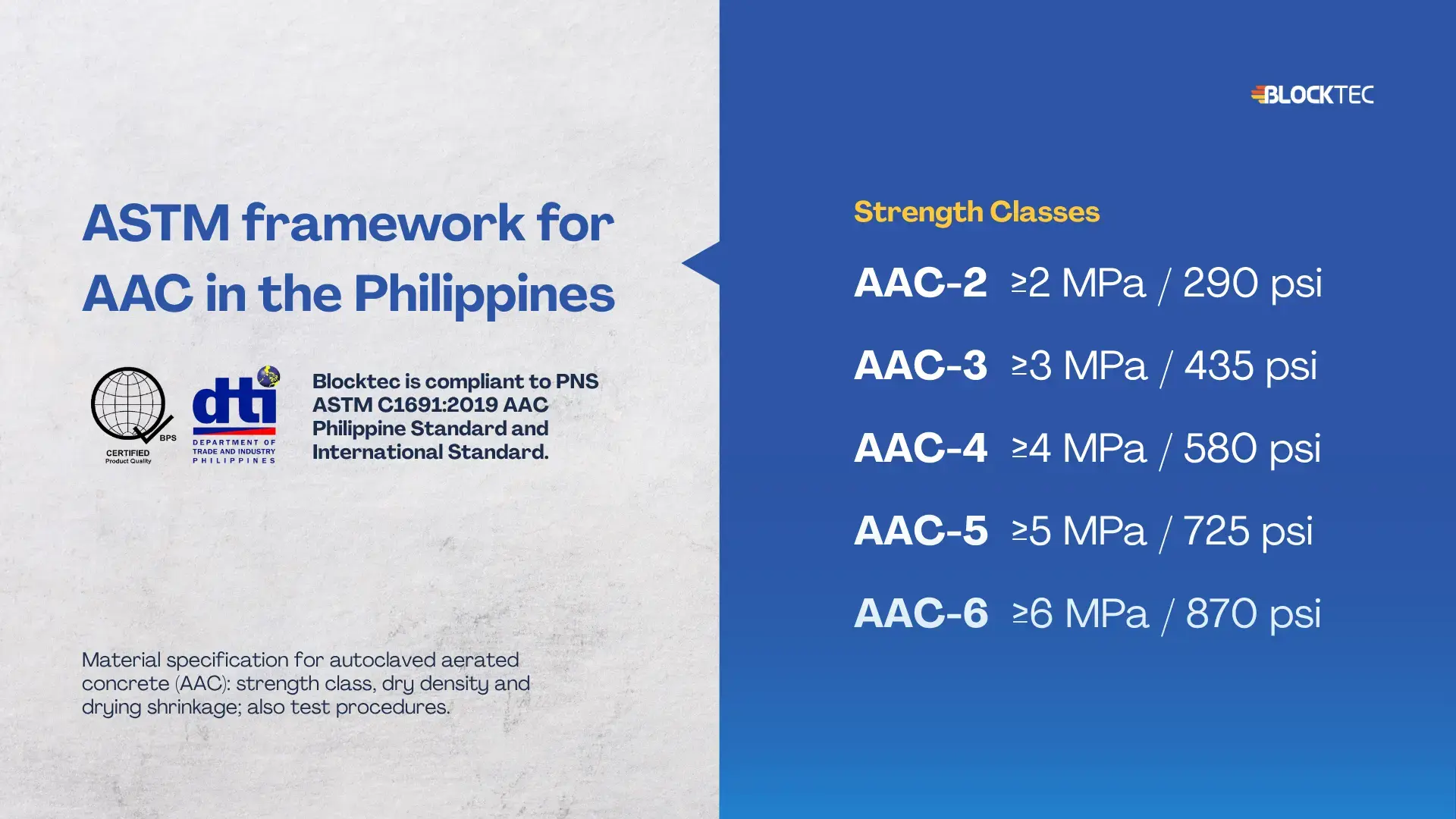
Comprehensive Data Comparison Table
The following technical data reflects the standard physical requirements for Autoclaved Aerated Concrete specified in Table 1 of ASTM C1693:
Step-by-Step Grade Analysis of Different Strength Classes of AAC Blocks
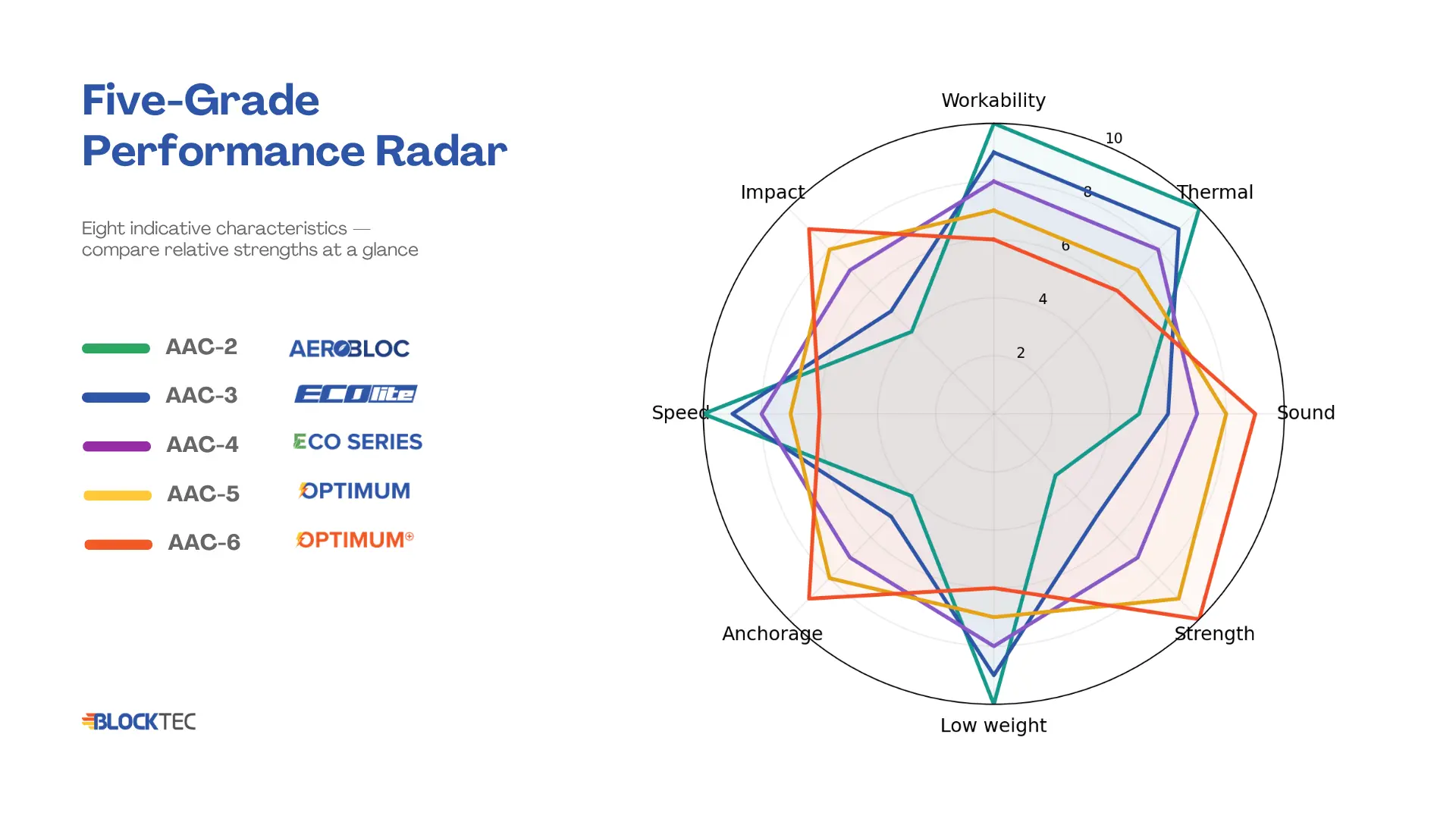
Specifying the correct AAC block grade depends on structural demands, wall location, mechanical anchor loads, and project performance criteria.
AAC-2 (Ultra-Lightweight Infill Grade)
- Compressive Strength: Minimum 290 psi (2.0 MPa).
- Dry Bulk Density: 450 kg/m³
- Site Engineering Context: AAC-2 is engineered purely to minimize structural dead load on long-span suspended slabs and high-rise frames where physical wall stresses are minimal.
- Jobsite Trade-Off: Because of its lower density, AAC-2 offers lower point-load anchorage capacity. If your architectural plans call for heavy wall-hung cabinets, heavy MEP equipment, or stone cladding, you will need secondary anchor backings or higher density grades.

Aerobloc
This product is perfect for projects needing low wall dead load, easy handling, and enhanced thermal insulation at lower density. It's suitable for housing, hotel partitions, and high-rise non-loadbearing infill, requiring specific wall design and fixing standards.
Recommended applications
- Residential partitions
- Low-cost housing
- Detached residences
- Office partitions
- Farm Houses
- Mixed-use developments
AAC-3 & AAC-4 (General-Purpose & Partition Workhorse)
- Compressive Strength: Minimum 435 psi (3.0 MPa) for AAC-3; 580 psi (4.0 MPa) for AAC-4.
- Dry Bulk Density: 500-600kg/m³.
- Site Engineering Context: The industry workhorse for interior layout partitions in residential, commercial, and institutional projects. Commercial offerings like the Blocktec Eco Series (508–580 psi range) and Ecolite Series fit cleanly into this structural category.
- Jobsite Utility & Tooling: Masons can rapidly cut these blocks to custom dimensions right on the floor using a specialized Carbide Saw, avoiding messy block breakage. Laying units using a dedicated Notched Trowel ensures a uniform 2–3 mm bed of Blocktec Premium Thin-Bed Adhesive (BT-100), while pre-cast AAC Lintel Beams (200mm x 1600mm) installed over door and window openings eliminate the time and formwork needed to pour conventional RC stiffener lintels.

Ecolite
The material provides a slight boost in nominal compressive strength while remaining lightweight. It is suitable for townhouses, apartments, dormitories, office partitions, and low- to mid-rise mixed-use developments.
Recommended applications
- Townhouses
- Apartments
- Condos
- Dorms
- Schools & Offices
- Hi-rise Residences

Eco Series
A mid-range AAC option for partitions in residential, commercial, and institutional settings, suitable for schools, clinics, retail spaces, offices, and hotels, meeting impact, anchorage, acoustic, and fire standards
Recommended applications
- Shopping Malls
- Mid-rise mixed use
- Hi-rise mixed use
- Restaurants
- Retails
- Hospitals
AAC-5 & AAC-6 (High-Strength & Heavy-Duty Grade)
- Compressive Strength: Minimum 725 psi (5.0 MPa) for AAC-5; 870 psi (6.0 MPa) for AAC-6.
- Dry Bulk Density: 650-700kg/m³.
- Site Engineering Context: Heavy-duty masonry units designed for high-wind exterior building envelopes, perimeter security walls, and heavy fixture anchor zones. Standard commercial options include the Blocktec Optimum Series (600–725 psi) and Optimum+ Series (800–870 psi).
- Jobsite Utility: Provides maximum anchor pull-out resistance for expanding mechanical anchors, exterior curtain wall brackets, and heavy utility piping supports.

Optimum Series
AAC-5 is a lighter-weight alternative to AAC-6 when both are produced at progressively increasing densities. It offers higher nominal strength than AAC-4 and may suit medium-to-high- use corridors, hospitals, warehouses, service rooms and industrial partitions. It has a higher anchorage load and impact performance.
Recommended applications
- Logistic Centers
- Manufacturing Plants
- Data Centers
- Server Rooms
- Recording Studio
- Food Processing

Optimum Plus Series
AAC-6 is the top compressive-strength class suitable for high-traffic industrial and commercial areas, including factory corridors, warehouse partitions, loading areas, data centers, and transport facilities. Its higher density may improve airborne sound isolation and anchorage potential, but it also means greater wall weight and typically less thermal insulation than lower-density AAC.
Recommended applications
- Data Centers
- Heavy Use Warehouses
- Electrical Areas
- Train & Airport Facilities
- Telcom Equipment Room
- Military Offices
Technical Material Properties & Shrinkage Resistance
To understand AAC performance, you need to look at its batching and curing process. Raw materials—portland or blended cement, quartz sand, lime, calcined gypsum, water, and aluminum powder expansion agents—are thoroughly slurry-mixed and cast into molds. Chemical reactions cause the slurry to expand into a lightweight mass filled with macroscopic voids. Once set, the mass is machine-cut into precise block dimensions and cured under high-pressure steam in autoclaves to form a structurally stable calcium silicate crystal network.
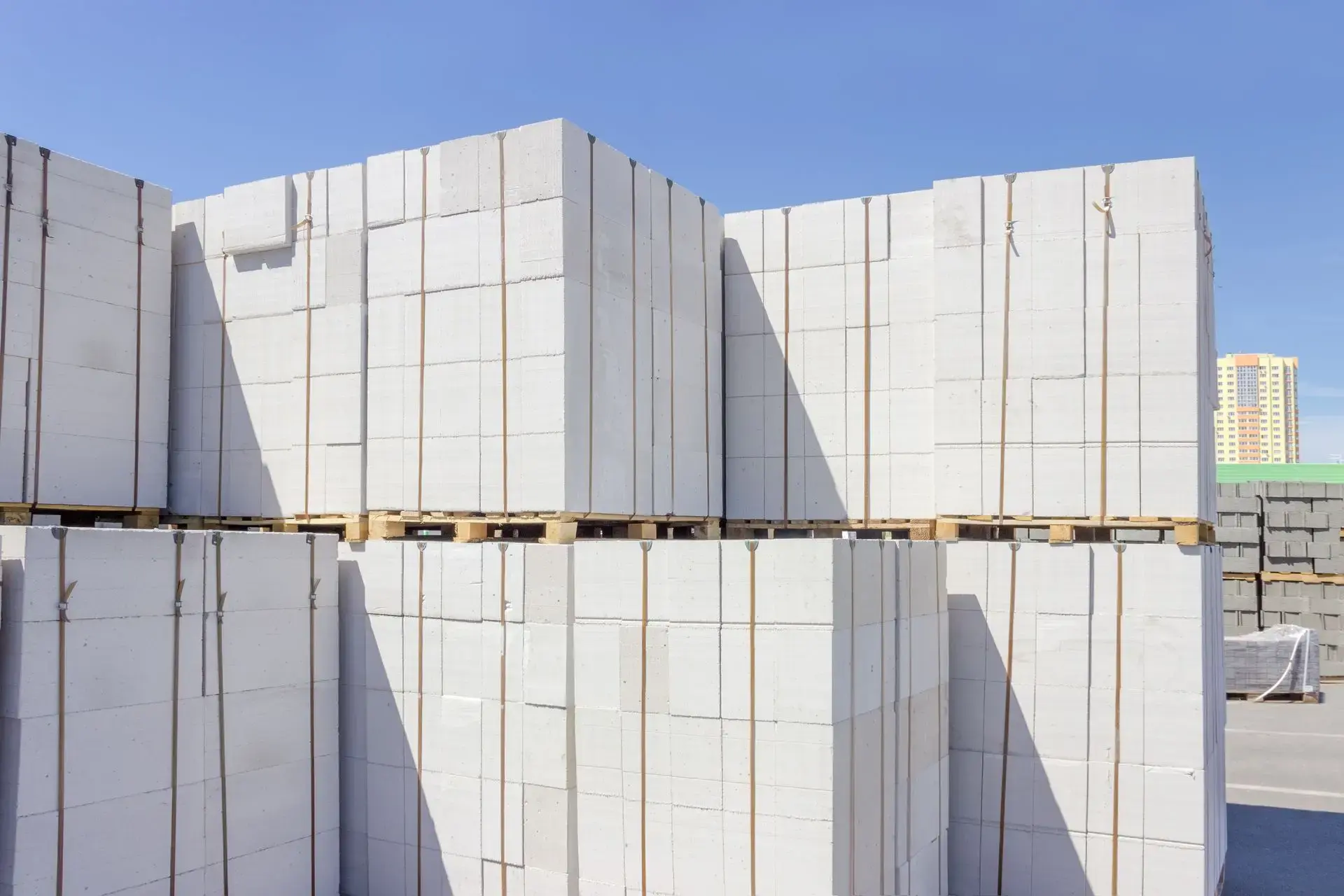
The critical metric for site engineers to note in ASTM C1693 is the mandatory drying shrinkage limit of ≤ 0.02% across all strength classes. Field-cured Concrete Hollow Blocks constantly contract as water evaporates, causing severe hairline cracks across finished walls. Autoclaved AAC units complete their chemical transformation inside the pressure vessel, resulting in decrease in post-installation shrinkage on site.
Universal Site Benefits of the AAC System
Regardless of whether your project calls for AAC-2 or AAC-6, replacing traditional hollow blocks with an engineered AAC wall system delivers universal site efficiency and cost savings.
"No More Palitada Na!" (Zero Plastering)
Traditional masonry requires a thick sand-cement plaster coat (palitada) on both faces to hide block roughness and cover curing cracks. Because AAC blocks are precision machine-cut during factory production, individual block tolerances are held within tight dimensional limits (±3 mm).
- Bypasses Plastering Completely: Masons assemble blocks using thin-bed adhesive and apply skimcoat directly to the flat AAC surface.
- Why Direct Skimcoating Works: Because AAC units are factory autoclaved, their low drying shrinkage (≤ 0.02%) prevents post-installation wall cracking. You don't need thick plaster to bridge shrinkage gaps.
- Financial Advantage: Eliminates tons of sand and cement delivery, cuts water usage, slashes site cleanup, and reduces overall wall system construction costs by up to 21%.
Rapid Wall Productivity
Traditional CHB installation is slow, requiring heavy mortar mixing and continuous leveling adjustments. AAC dramatically increases daily floor accomplishment:
- Standard Shift Accomplishment: A single trained mason with a helper completes 10 to 12 m² of wall area per 8-hour shift.
- Straight Run Accomplishment: On long, straight wall layouts without door or window openings, production reaches up to 20 m² per 8-hour shift.
4-Hour Fire Resistance Rating
AAC features a uniform macroscopic cellular structure resembling a honeycomb. This microscopic air-cell entrapment acts as a thermal barrier, giving standard AAC walls an official 4-hour fire resistance rating. This makes it an ideal choice for property-line fire walls and critical exit enclosures without requiring extra fireproofing layers.
Thermal Insulation & 30% Energy Savings
Heavy concrete materials readily absorb and conduct heat into building interiors. AAC blocks exhibit remarkably low thermal conductivity. Buildings constructed with AAC walls maintain cooler indoor temperatures, directly lowering air conditioning cooling loads and delivering up to 30% energy savings on HVAC operational power bills.
Acoustic Performance Metrics
In multi-family residential towers, hotel partitions, and office developments, sound control between rooms is crucial. Standard engineered AAC wall assemblies deliver effective sound attenuation (typically achieving benchmark acoustic ratings around STC 44 in tested wall configurations).
Verification, Certification, and Actionable Conclusion
Quality You Can Verify (PS Certification Mark Q-6620)
Material quality control is non-negotiable on any commercial jobsite. To ensure structural safety and standard compliance, always verify that your supplier carries national quality approvals.
Blocktec holds the distinction of being the first AAC importer in the Philippines to earn the Department of Trade and Industry (DTI) Bureau of Philippine Standards (BPS) Philippine Standard (PS) Quality Certification Mark (License No. Q-6620).
This certification verifies that imported Blocktec AAC blocks strictly comply with PNS ASTM C1691 / ASTM C1693 criteria for minimum compressive strength, bulk density limits, drying shrinkage (≤ 0.02%), and dimensional accuracy (±3 mm).
Summary Takeaways for Site Engineers & Estimators
- Match Strength Class to Wall Function: Specify AAC-2 to AAC-4 (such as Blocktec Eco Series / Ecolite Series) for interior non-load bearing infill to slash structural dead load. Specify AAC-5 to AAC-6 (such as Blocktec Optimum Series / Optimum+ Series) for special building like data center, x-ray rooms, airport rooms and heavy anchorage zones.
- Eliminate Plastering & Increase Output: Utilize thin-bed mortar and direct skimcoating to bypass traditional palitada—cutting total wall system construction costs by up to 21% while hitting up to 20 m² daily mason output on straight runs.
- Verify Quality Standards: Ensure every batch delivered to your jobsite carries official DTI-BPS PS Certification (License No. Q-6620) to guarantee material performance.
Ready to Optimize Your Project Budget and Timeline?
Don't let outdated masonry methods slow down your floor turn-overs. Submit your project blueprints to Blocktec today for a complete AAC wall system calculation and free material quotation!
- Website: www.blocktec.ph
- Direct Hotline: 0917-168-1769
- Sales Email: sales@blocktec.ph
- Strategic Supply Hubs: Metro Manila (Marikina), Subic, Laguna (Cabuyao)