
When planning a building or custom home, most people focus on high-efficiency HVAC systems, smart thermostats, or LED lighting to keep energy costs down. While these are great additions, they only address the symptoms of energy loss. To truly build an energy-efficient structure, you have to look at the building envelope itself—specifically, the walls.
In traditional construction, concrete masonry and clay bricks act as "thermal bridges," easily transferring outdoor heat or cold into your living spaces and forcing your air conditioning or heating to run continuously.
Autoclaved Aerated Concrete (AAC) blocks and panels offer a revolutionary alternative. By combining lightweight structural capability with top-tier thermal performance, AAC acts as a permanent, maintenance-free thermal shield. Research shows that building with AAC can reduce heating and cooling demands by up to 25% to 30%, drastically lowering your monthly utility bills.
Here is a scientific breakdown of how AAC lowers energy consumption, and how you can maximize these savings on your next project.
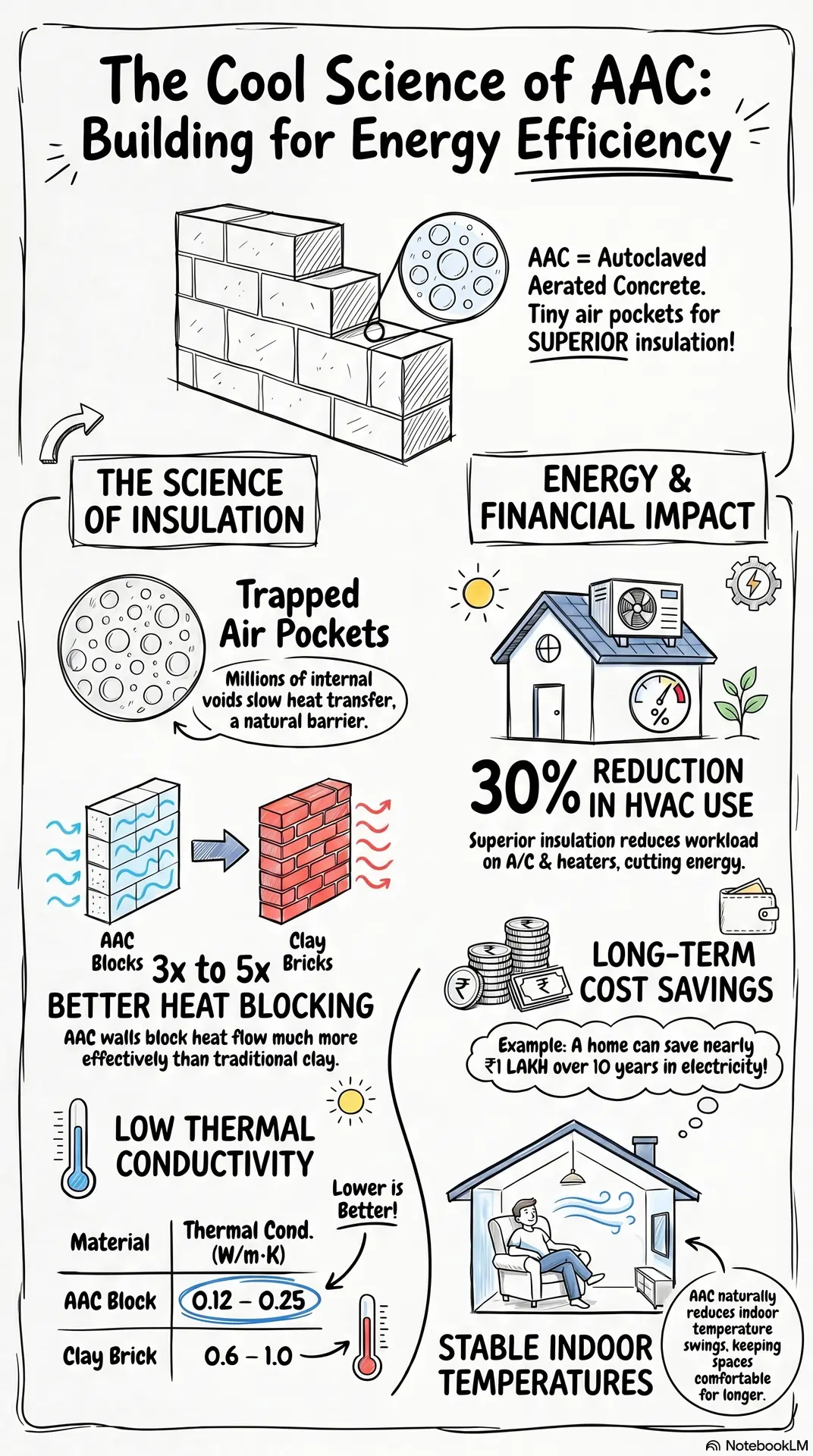
1. The Secret Weapon: Trapped Microscopic Air Voids
At the heart of AAC's insulating power is still air—one of nature's best natural insulators.
During manufacturing, a chemical expansion process creates a highly porous structure where 60% to 80% of the total volume is comprised of trapped macroscopic air pockets. These voids prevent heat from easily moving through the material.
This unique structure gives AAC an incredibly low thermal conductivity (k-value):
Thermal Conductivity Chart: AAC vs Traditional Materials
- AAC Blocks: Range from 0.12 to 0.25 W/m·K (and as low as 0.07 W/m·K for lighter densities).
- Clay Bricks: Range from 0.60 to 1.0 W/m·K.
- Traditional Concrete: Frequently exceeds 1.4 W/m·K.
In simple terms, AAC walls block heat flow 3 to 5 times more effectively than clay brick walls, keeping indoor spaces stable and comfortable year-round.
2. Steady-State R-Value vs. The Thermal Mass Effect
In construction, thermal performance is typically measured in R-value (resistance to heat flow). While a standard 8-inch solid concrete wall has very little thermal resistance, an 8-inch (200mm) AAC wall delivers a steady-state R-value of approximately 10.
However, AAC's real-world performance is even higher due to the Dynamic Benefit for Massive Systems (DBMS), or the thermal mass effect.
How DBMS Saves You Money:
Because AAC has an optimum combination of density and heat storage capacity, it temporarily stores thermal energy instead of instantly passing it inside.
- Summer/Warm Climates: When the midday sun beats down on your exterior walls, the AAC block absorbs the heat. The heat transfer is delayed by several hours (known as "thermal lag"). By the time that heat reaches the interior, the sun has set, outdoor temperatures have dropped, and the stored heat is naturally released outward into the cool night air.
- Winter/Cold Climates: During winter, the high heat capacity of AAC walls helps retain indoor warmth, drastically minimizing the need for continuous heating systems.
3. The Airtight Envelope Advantage
Even high-value insulation will fail if a building leaks air. Drafts and air infiltration are major sources of energy loss in residential and commercial properties.
AAC wall systems provide excellent airtightness and low levels of thermal transmittance (U-values). Because AAC blocks are precision-engineered and installed with thin joint lines, they create a highly continuous, tightly sealed building envelope. This structural airtightness prevents cooled or heated indoor air from escaping, ensuring your HVAC system runs as efficiently as possible.
What the Research Says: Proven Energy Savings
AAC’s energy conservation capabilities are not just theoretical—they are backed by decades of international laboratory testing and building simulations:
- The Oak Ridge National Laboratory (ORNL) Study:
Using DOE 2.1E whole-building modeling across six different climates, researchers simulated the performance of an AAC-unit house compared to a lightweight wood-frame house.
- In hot climates (like Phoenix), a conventional wood-frame wall would require an R-value 133% higher than the AAC wall to achieve the same heating and cooling loads.
- Even in cold climates (like Minneapolis), a wood-frame wall required an R-value 31% higher than AAC for equivalent performance.
- Energy and Buildings Journal: Published research demonstrates that buildings constructed with AAC consistently reduce heating and cooling energy demands by up to 30%, directly translating to lowered utility bills.
- LEED Green Building Certification: Due to its high R-values and thermal mass, using AAC in your building envelope can earn up to 19 points under EA Credit 1 (Optimize Energy Performance). The program recognizes AAC-engineered envelopes for driving 12% to 48% energy cost savings in new constructions.
Two Crucial Installation Best Practices to Protect Your Savings
To ensure you get the absolute maximum energy savings from your AAC building, make sure your contractor avoids these two common pitfalls:
1. Keep the Walls Dry (Prevent the Moisture Trap)
AAC is a highly porous material. While dry air trapped in the pores acts as an outstanding insulator, water is a highly efficient heat conductor.
- The Risk: Experimental studies on G2/04 class AAC show that when the moisture content in the block reaches 41.5%, its thermal conductivity increases up to 3.5-fold compared to its dry state. Moist walls will cause your energy consumption to rise dramatically.
- The Solution: Always protect your exterior walls from rain penetration. Ensure the exterior is finished with a high-quality, breathable elastomeric paint, plaster, or water-repellent sealer that blocks liquid water while allowing vapor to escape.
2. Avoid Linear Thermal Bridging (Use Thin-Bed Mortar)
- The Risk: Traditional cement-sand mortar joints are thick (10mm to 15mm) and act as mini heat highways, allowing energy to bypass the insulating blocks.
- The Solution: Always install AAC blocks using specialized thin-bed adhesive mortar (resulting in precise 2mm to 3mm joint lines). This minimizes linear thermal bridging, maintaining a uniform insulating barrier across the entire wall.
⚡The Bottom Line
Switching to AAC blocks is an investment that actively pays you back. By utilizing the natural insulating properties of trapped air and leveraging structural thermal mass, AAC takes the heavy lifting off your air conditioner and heater. You get a structurally superior building that stays naturally comfortable, retains its value, and lowers your monthly power bills for decades to come.
Scientific References & Cited Studies
- U.S. National Bureau of Standards (NBS) & Department of Energy (DOE):
- A Review of Autoclaved Aerated Concrete Products (NIST Technical Series). Comprehensive review of the raw materials, density, thermal conductivity, and energy considerations of cellular concrete.
- Oak Ridge National Laboratory (ORNL) - Buildings Technology Center:
- Shukla, N., Elliott, D., Urban, B., Fallahi, A., & Kosny, J. Thermal and Energy Performance of Autoclaved Aerated Concrete (AAC). Real-world material testing and computer modeling comparing lightweight AAC to standard insulated CMU blocks.
- Kosny, J. Whole Wall Performance Analysis of Autoclaved Aerated Concrete. A collaborative study verifying clear-wall R-values, thermal bridging at interfaces, and validating the Dynamic Benefit for Massive Systems (DBMS) using guarded hot-box testing.
- Energy and Buildings Journal:
- Improving the Energy Efficiency in Buildings Using Autoclaved Aerated Concrete. Direct analysis showing up to a 30% reduction in operating thermal loads.
- International Moisture & Thermal Research:
- Effect of Moisture and Temperature on Thermal Conductivity of G2/04 Class Autoclaved Aerated Concrete. Laboratory testing illustrating the critical 3.5-fold increase in thermal conductivity under high humidity and water absorption.
- European Autoclaved Aerated Concrete Association (EAACA):
- Net-Zero Roadmap. Outlines thermal insulation standards, low thermal transmittance (U-values), and air tightness capabilities of cellular structural systems.